The Hunger Games Books: A Dystopian Masterpiece That Defined a Generation 📚🔥
Suzanne Collins' The Hunger Games trilogy isn't just young adult fiction—it's a cultural phenomenon. Since the first book's release in 2008, this dystopian series has sold over 100 million copies worldwide, spawned four blockbuster films starring Jennifer Lawrence, and fundamentally reshaped the landscape of speculative fiction. But beyond the arena battles and Capitol extravagance lies a nuanced exploration of power, trauma, and resistance that continues to resonate in our increasingly media-saturated world.
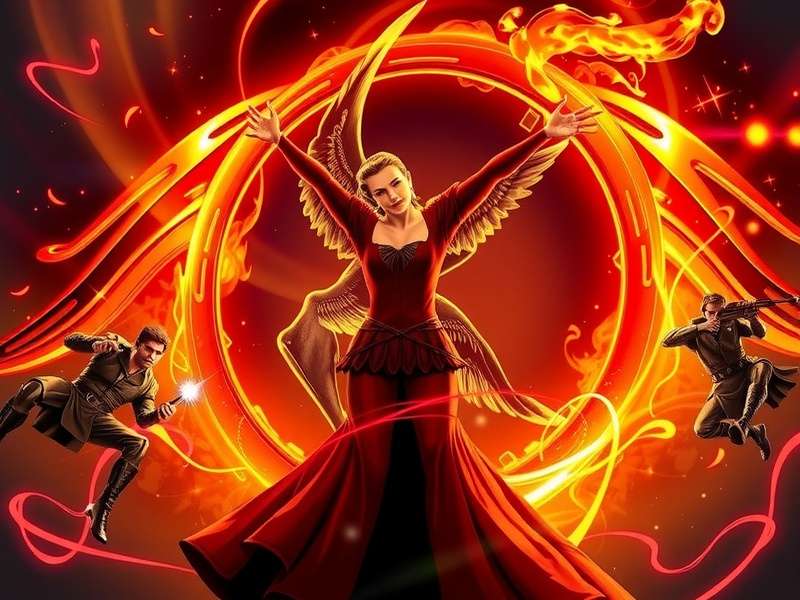
Beyond the Arena: The Literary Architecture of Panem
When readers first meet Katniss Everdeen in The Hunger Games, they're immediately thrust into District 12's harsh reality. Collins' world-building operates on multiple levels—the physical geography of Panem, the socio-political hierarchy, and the psychological landscape of its characters. What many casual readers miss is how meticulously Collins mirrors historical regimes: the Capitol's excess echoes ancient Rome's bread and circuses, while the Districts' oppression reflects various colonial and industrial exploitation models.
The Hunger Games series books employ a first-person present tense narrative—a relatively uncommon choice in young adult literature at the time. This technique creates immediate, visceral tension. Every decision, every moment of hesitation, is experienced in real-time with Katniss. This narrative intimacy is crucial for understanding her complex psychology, particularly her PTSD development across the trilogy.
Chapter-by-Chapter Analysis: The Original Trilogy's Hidden Symbols
The Hunger Games (2008): More Than Survival
While the first book is often reduced to "battle royale" premise, its genius lies in the political symbolism embedded in seemingly minor details. The mockingjay pin isn't just jewelry—it represents unintended consequences, rebellion born from control. The bread Peeta gives Katniss isn't just kindness; it's the first crack in District 12's individualistic survival mentality. Collins seeds revolutionary concepts in these small acts.
"I am not pretty. I am not beautiful. I am as radiant as the sun." — Katniss Everdeen, The Hunger Games
Catching Fire (2009): The Spark Becomes Flame
The Quarter Quell's twist—forcing previous victors back into the arena—isn't just narrative cruelty. It demonstrates the Capitol's understanding that hope is more dangerous than despair. By targeting symbols of hope (the victors), Snow attempts to crush the districts' spirit. Yet this backfires spectacularly, as Katniss' wedding dress transformation into a mockingjay becomes the rebellion's visual manifesto.
Mockingjay (2010): The Cost of Revolution
The final book's controversial departure from arena games was a bold narrative risk. By focusing on propaganda warfare and political manipulation, Collins forces readers to confront uncomfortable questions: Is District 13's rebellion morally superior to the Capitol? Does replacing one authoritarian system with another constitute victory? Katniss' assassination of Coin instead of Snow remains one of YA literature's most politically sophisticated moments.
The Prequel Renaissance: "The Ballad of Songbirds and Snakes"
Released in 2020, The Hunger Games The Ballad Of Songbirds Snakes provided the backstory fans didn't know they needed. By exploring 18-year-old Coriolanus Snow's mentorship of Lucy Gray Baird, Collins accomplishes something remarkable: she makes readers sympathize with a future tyrant while never excusing his actions.
The prequel's examination of the Games' early days—crude, unpopular, and struggling for viewership—offers a chilling commentary on entertainment desensitization. As Snow helps "produce" the 10th Hunger Games for maximum audience engagement, we witness the birth of the spectacle-obsessed culture that defines the original trilogy.
The Audiobook Experience: A Different Way to Visit Panem
For many fans, The Hunger Games audiobook narrated by Tatiana Maslany (trilogy) and Santino Fontana (prequel) offers a fresh perspective. Maslany's ability to capture Katniss' internal conflict—the flat affect masking seismic emotional shifts—adds layers even seasoned readers might miss. The audio format particularly enhances the arena sequences, where environmental sounds and pacing create cinematic tension.
From Page to Screen: What the Films Got Right (and Wrong)
The Film Hunger Games adaptation faced immense pressure to satisfy devoted readers while creating accessible cinema. Director Gary Ross' decision to maintain the first book's first-person perspective through shaky-cam and close-ups was controversial but largely successful. The films' greatest contribution might be their expansion of scenes outside Katniss' perspective, particularly Snow's war room discussions, which the books could only hint at.
However, certain subtle book elements were inevitably lost. The film's quicker pacing reduces the psychological weight of Katniss' starvation trauma and her complex relationship with her mother. Peeta's loss of leg receives less emphasis, diminishing the physical cost of survival.
The Genre Debate: More Than "Young Adult Dystopia"
Asking What Genre Is Hunger Games reveals the series' hybrid nature. While marketed as YA dystopia, it incorporates elements of war fiction, political thriller, psychological drama, and even satire. The books' sophisticated exploration of propaganda techniques and media theory places them in conversation with adult works like Orwell's "1984" and Huxley's "Brave New World."
Tribute Community Feedback
Share your thoughts on the books. Your review helps other fans discover deeper meanings.
Join the Discussion